What Percent of Juvenile Offenders Reoffend Again
| The overall proven reoffending rate was 26.0% for the July to September 2022 offender accomplice. | This represents a decrease of 2.half-dozen percentage points from the same quarter in 2018, the largest year-on-year subtract and the lowest rate in the timeseries. |
| Adult offenders had a proven reoffending rate of 25.6% | This is a decrease of 2.3 per centum points since the aforementioned quarter in 2022 and the everyman rate in the timeseries. |
| Juvenile offenders had a proven reoffending charge per unit of 33.0%. | The juvenile reoffending charge per unit decreased by six.six percentage points from the same quarter in the previous yr. However, for context, the number of offenders in the cohort has fallen past 88% since the same quarter in 2008. |
| Adults released from custody or starting courtroom orders had a proven reoffending rate of 33.4% | This represents a 2.8 percentage betoken decrease since the same quarter last yr, a seven.0 percentage point decrease since the aforementioned quarter in 2011 and the lowest rate in the timeseries. |
| Adults released from custodial sentences of less than 12 months had a proven reoffending rate of 59.7%. | This is a decrease of two.3 percentage points from the same quarter in the previous year. Those released from sentences of less than or equal to half dozen months had a proven reoffending rate of 62.0%, which is besides a decrease of two.3 pct points since the same quarter in 2018. |
This bulletin, associated tables and data tools present the proportion of offenders who reoffend (proven reoffending charge per unit) and the number of proven reoffences by offender history, demographics and geography. For technical details please refer to the accompanying guide to proven reoffending statistics.
For any feedback related to the content of this publication, delight allow us know at ESD@justice.gov.uk
"Figures presented in this statistical release show proven reoffending statistics for the July to September 2022 offender cohort. However, they also include figures for the previous cohort (i.e. April to June 2019), the statistical release for which had previously been cancelled [footnote one]. Proven reoffences are measured over a one-year follow-up period and a farther 6-month waiting period to allow for offences to be proven in court. For the July to September 2022 offender cohort (equally well as the previous cohort), it is worth noting therefore that both the follow-up and waiting periods overlap with the stage when operational restrictions were implemented following the response to the COVID-19 pandemic.
Limits on criminal courtroom activity during leap 2022 meant a reduction in the volumes of cases candy and an increase in outstanding cases in Magistrates' and Crown Courts[footnote 2]. In addition, police recorded crime figures roughshod substantially during the first lockdown period, decreasing by 19% in April to June 2022 compared to the aforementioned quarter in 2019. Specifically, the greatest decreases were observed in theft and robbery offences (reductions of 43% and 47% respectively over the same period)[footnote 3].
The overall proven reoffending rate was 26.0% for the July to September 2022 offender cohort; this represents a 2.six percentage indicate decrease from the same quarter in 2018. This follows a more marked downward trend in the reoffending charge per unit amidst offender cohorts affected past the touch of the pandemic; information technology represents the largest year-on-yr decrease since the same quarter in 2008 and the lowest rate in the timeseries. More broadly, the boilerplate number of reoffences per reoffender (also known every bit the frequency rate) had gradually been increasing since 2009, indicating that a higher number of reoffences were being committed by a smaller number of individuals. However, standing with a general reduction in the frequency rate for more recent offender cohorts, the latest figure of 3.75 reoffences per reoffender is the lowest rate since July to September 2015.
The trends in the reoffending and frequency rates are broadly reflected in separate figures for adults and juveniles . Furthermore, the size of the overall cohorts continues to decrease, with both the adult and juvenile cohorts showing general decreases over fourth dimension. In particular, the juvenile cohort has shown the greatest subtract (a fall of 88% since the same quarter in 2008) with information technology at present making up just half dozen% of the overall accomplice compared to xx% for the aforementioned period in 2008. Whatsoever marked change in offender cohorts may likewise affect the rates, both in terms of volatility within the series, and in the offender mix making upward the offender cohorts, which is why caution should be exercised when making comparisons of actual rates over time.
Following the previous statistical release which reported on the figures for the Jan to March 2022 offender cohort, we keep to meet an effect of the pandemic on proven reoffending. Equally both the reoffending follow-upward and waiting periods take moved further into the stage of the first lockdown, it is likely that the more pronounced differences observed are due to a combination of limits in courtroom and possible changes in offending behaviour. Although the follow-up and waiting periods for the latest offender cohorts take as well started to coincide with the phased reopening of courts and the lifting of the first gear up of lockdown restrictions , future releases of the proven reoffending statistics will help better establish what the likely effects are as the courts work through their backlog of cases."
1.1 How is proven reoffending measured?
An offender enters the cohort if they were released from custody, received a non-custodial conviction at court or received a reprimand or warning in a three-month flow: July to September 2019. It is important to annotation that this is non comparable to publications prior to the October 2022 proven reoffending publication, which reported on a 12-month accomplice.
A proven reoffence is defined as any offence committed in a one-twelvemonth follow-upwards period that leads to a court conviction, circumspection, reprimand or warning in the 1-year follow-up or within a further six-month waiting catamenia to let the offence to be proven in court every bit shown in the diagram below in relation to the latest offender accomplice.
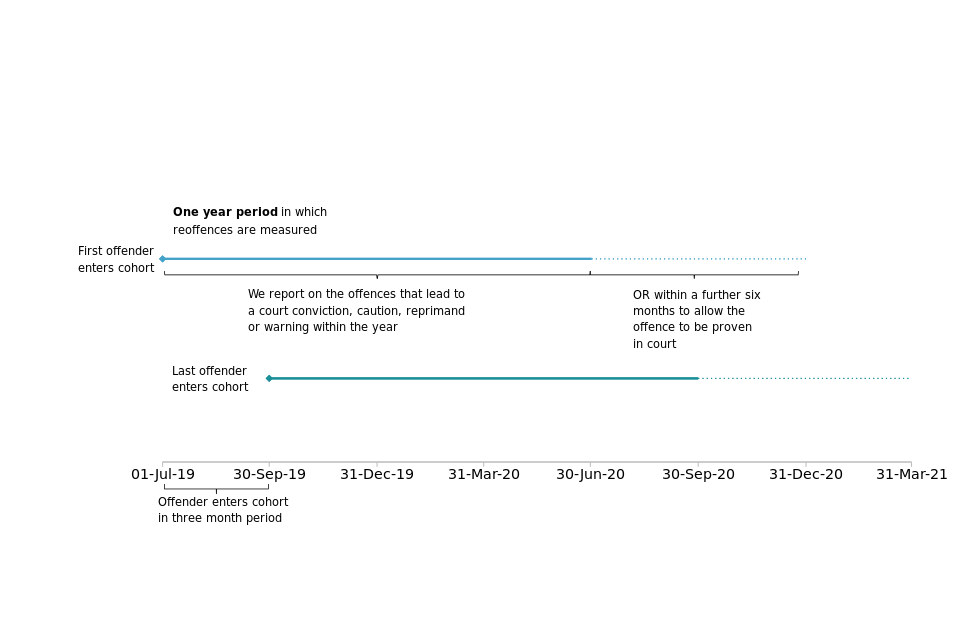
The timeseries presented in this publication spans the April to June 2008 through to the July to September 2022 offender cohorts. Accompanying quarterly tables also include figures for the April to June 2022 offender cohort, the statistical release for which had previously been cancelled[footnote ane]; for an illustration of the one-year follow-upwardly and waiting periods for this April to June 2022 offender accomplice, delight refer to the guide to proven reoffending statistics.
Latest proven reoffending statistics based on annual average cohorts can be found at: https://avails.publishing.service.gov.uk/government/uploads/arrangement/uploads/attachment_data/file/989447/Proven-reoffending-jan19-mar19-annual_tables_FINAL.ods.
Users should be cautious when making any comparing between cohorts before and later October 2015. This is because there is a change in information source from October 2022 onwards. In addition, users should be cautious when comparing the 3-monthly cohorts to 1 some other (e.thousand. October to Dec 2022 to July to September 2018). This is due to the smaller 3-month cohort size the measure is likely to exist more variable than the previous 12-month accomplice measure of reoffending. For further details on this, and how proven reoffending is measured, please meet the guide to proven reoffending statistics and 'How the mensurate of proven reoffending has changed and the effect of these changes'.
two. Overall – adult and juvenile offenders
The overall proven reoffending rate was 26.0% for the July to September 2022 offender accomplice.
This represents a subtract of two.six percentage points from the same quarter in 2018, the largest year-on-year decrease and the lowest charge per unit in the timeseries.
Proven reoffences are measured over a ane-twelvemonth follow-up period and a further six-month waiting period to allow for offences to exist proven in court. For the July to September 2022 offender cohort, too every bit the previous cohort (i.e. April to June 2019), both the follow-upwardly and waiting periods overlap with the phase of operational restrictions in spring 2022 following the response to the COVID-19 pandemic. Limits on criminal court activeness over this period meant a reduction in the volumes of cases processed and an increase in outstanding cases in Magistrates' and Crown Courts[footnote 2]. In improver, this also coincides with the first set of lockdown restrictions put in place more generally which may have had an issue on offending behaviour. Every bit a result, and following on from the figures observed for the Jan to March 2022 offender cohort reported on in the previous statistical release, we go along to see a more marked effect on proven reoffending.
The overall proven reoffending charge per unit, based on simply over 96,000 developed and juvenile offenders (made upwardly of 94% adults and 6% juveniles)[footnote 4] in the July to September 2022 accomplice was 26.0%, a ii.half-dozen percent point subtract from the same quarter in 2022 (figure i). This follows a downward trend for offender cohorts afflicted by the impact of the pandemic and represents the largest year-on-year decrease since the same quarter in 2008 and the lowest rate in the timeseries. Over time, the overall proven reoffending rate has fluctuated between 26.0% and 31.8%.
Just over 25,000 of these offenders in the latest cohort and then committed almost under 94,000 proven reoffences over a ane-twelvemonth follow-upwards flow, equivalent to an average of 3.75 reoffences each (also known every bit the frequency rate). More broadly, the fequency rate gradually increased since 2009, indicating that a higher number of reoffences were gradually being committed by a smaller number of individuals. Notwithstanding there has been a general reduction in the frequency rate for more contempo offender cohorts, with the latest figures representing the lowest rate since July to September 2015.
Figure i: Proportion of adult and juvenile offenders in England and Wales who commit a proven reoffence and the number of offenders in each cohort, April 2008 to September 2022 (Source: Table A1)

Of this offender cohort, 83% were male and 17% were female, with the gender split remaining reasonably stable over time. Male offenders reoffended at a higher charge per unit of 27.1% compared to female person offenders who reoffended at a charge per unit of 20.eight%. Since 2008, these rates have fluctuated between 27.ane% and 33.nine% for males and 20.8% to 24.4% for females.
3. Developed offenders
Adult offenders had a proven reoffending rate of 25.6%.
This is an subtract of 2.3 per centum points since the same quarter in 2018, and the everyman rate in the timeseries.
The adult reoffending rate had remained broadly flat since 2008. However, the latest figure for the July to September 2022 cohort was 25.half-dozen%, a 2.3 percentage point decrease since the same quarter in 2022 and the lowest rate in the timeseries. This also follows a reduction since the April to June 2022 cohort menstruum when the rate stood at 25.eight% and represented the largest twelvemonth-on-year decrease in the timeseries so far. Over fourth dimension, the rate has fluctuated betwixt 25.6% and 30.6%. As with the overall proven reoffending rate, the continuing reduction in the rate for more than recent cohorts may predominantly be due to the effects of the COVID-19 pandemic, as outlined before.
For the latest quarterly cohort, just over 87,000 proven reoffences were committed over the one-year follow-up period by over 23,000 of adults. Those that reoffended committed on average three.74 reoffences; this represents a 7% subtract compared to the same quarter in 2022 and the lowest frequency charge per unit since July to September 2015. As with the overall frequency charge per unit, there has been a downwards tendency for more recent offender cohorts, following an increasing trend in previous years.
Figure 2: Proportion of adult offenders in England and Wales who commit a proven reoffence, past number of previous offences, July to September 2022 (Source: Table A5a)
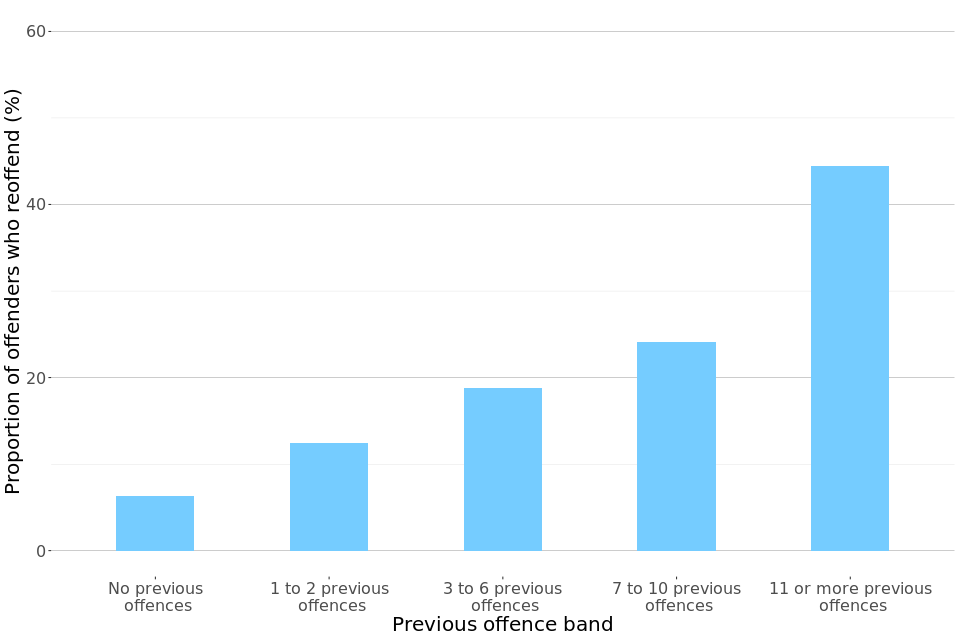
Offenders with a larger number of previous offences have a college rate of proven reoffending than those with fewer previous offences. In the July to September 2022 cohort, the proven reoffending rates for adults ranged from half dozen.iii% for offenders with no previous offences to 44.five% for offenders with 11 or more previous offences (figure two).
Adult offenders with eleven or more than previous offences fabricated upwards twoscore% of all adult offenders in the cohort, represented 69% of all adult reoffenders and committed 79% of all developed proven reoffences.
4. Adjusted reoffending rates
When controlling for offender characteristics, 26.iv% of developed offenders in the cohort reoffended inside a yr.
This represents a subtract of one.six percentage points compared to the aforementioned quarter in 2018.
The raw proven reoffending rates take been adjusted against the 2011 calendar year, in line with the Payment by Results (PbR) statistics.[footnote v] These adjusted rates for adults are calculated by 'the proportion of offenders who reoffend' (proven reoffending charge per unit) for the cohort plus whatever deviation between the average Offender Grouping Reconviction Scale (OGRS4/G) score in that accomplice and the 2011 cohorts.[footnote 6]
Figure 3: The proportion of offenders who reoffend, the average OGRS scores and the adjusted proven reoffending rate for adults, April 2008 to September 2022 (Source: Table A1)

Between 2006 and 2011 the average OGRS score increased, but since 2011 it has remained relatively flat. This indicates that between 2006 and 2011 the cohort had an increasing propensity to reoffend, but since 2011 this has levelled off. As a issue, the raw reoffending rates for adults are adjusted upwardly between 2006 and 2011 reflecting the lower propensity to reoffend when compared to after cohorts.
Post-obit 2011 the raw rates and the adapted rates have tracked each other more closely (figure 3). For example, the raw reoffending rate for adults for the July to September 2022 period was 25.6% while the adapted rate was 26.iv%.
five. Juvenile offenders[footnote seven]
Juvenile offenders had a proven reoffending rate of 33.0%.
The juvenile reoffending rate decreased past 6.6 percentage points from the same quarter in the previous year.[footnote viii] However, for context, the number of offenders in the cohort has fallen by 88% since the aforementioned quarter in 2008.
The juvenile reoffending rate was 33.0%, a 6.vi percentage point decrease from the same quarter in the previous year. Just nether ii,000 of approximately five,000 juvenile offenders in the July to September 2022 cohort committed a reoffence within a i-twelvemonth follow-up period (equivalent to around 7,000 proven reoffences). Despite this accomplice likely to have too been impacted by the pandemic, it is important to note that the number of offenders in the cohort has fallen by 88% since the same quarter in 2008 and has fluctuated betwixt 33.0% and 43.six% over the years.
Those that reoffended committed on average 3.82 reoffences each. As with the adult cohort, juvenile offenders with 11 or more previous offences had a higher reoffending rate than those with no previous offences, 65.4% and 17.0% respectively.
Figure 4: Proportion of developed and juvenile offenders in England and Wales who commit a proven reoffence, by age, July to September 2022 (Source: Tabular array A3)

This quarter, xv to 17-year-quondam offenders take the highest reoffending rate, closely followed by the 10 to 14-twelvemonth-old offenders, with reoffending rates of 33.6% and 31.3% respectively (figure iv). The proven reoffending rate for juveniles is higher than adults and the rate starts to autumn with increasing age later on the 35 to 39-twelvemonth-sometime group.
6. Adult reoffending by disposal[footnote 9]
Adults released from custody or starting courtroom orders had a proven reoffending rate of 33.4%.
This represents a 2.8 pct bespeak subtract since the aforementioned quarter concluding year, a vii.0 percentage point decrease since the same quarter in 2011 and the lowest rate in the timeseries.
Adults released from custodial sentences of less than 12 months had a proven reoffending charge per unit of 59.7%.
This is a decrease of 2.iii percent points from the same quarter in the previous year. Those released from sentences of less than or equal to 6 months had a proven reoffending charge per unit of 62.0%, which is also a subtract of 2.3 percent points since the same quarter in 2018.
Adults released from custody or starting court orders had a proven reoffending rate of 33.four%, a decrease of 2.viii percentage points compared to the same quarter in 2022 and a decrease of vii.0 percentage points since the same quarter in 2011.
The proven reoffending charge per unit for adult offenders starting a court order[footnote 10] specifically was 29.6%, a 2.4 per centum point decrease compared to the same quarter in 2022 and a seven.iv percentage bespeak decrease when compared to the same quarter in 2011. When adjusted for offender mix (i.eastward. when controlling for offender characteristics), the decrease observed in 2011 is smaller at 2.4 percentage points.
Figure 5: Proportion of adult offenders released from custody who commit a proven reoffence, past custodial sentence length, April 2008 to September 2022 (Source: Table C2a)

The proven reoffending rate for adult offenders released from custody was 42.four%, a 3.three percentage betoken decrease compared to the aforementioned quarter the previous yr. However, adults who served sentences of 12 months or more reoffended at a substantially lower rate at 24.1% compared to those who served a sentence of less than 12 months at a rate of 59.seven% (figure five). Those released from sentences of less than or equal to vi months had a proven reoffending charge per unit of 62.0%, a decrease of 2.iii pct points since the same quarter in the previous yr. Users should exercise circumspection when comparing the effectiveness of different sentences because the presented rates do not command for known differences in offender characteristics receiving those sentences - for further information delight consult recent research on the bear on of short custodial sentences, community orders and suspended judgement orders on reoffending also as the guide to proven reoffending statistics.[footnote 11]
seven. Juvenile reoffending by disposal[footnote 12]
Juvenile offenders given youth cautions had a proven reoffending rate of twenty.7%.
The reoffending rate for juvenile offenders given youth cautions has decreased by 7.four pct points since the same quarter in the previous year.
Reprimands and warnings for youths were abolished under the Legal Aid Sentencing and Penalty of Offenders Act 2012 with effect from eight April 2013 and replaced with youth cautions. Youth cautions are a formal out-of-court disposal that can be used as an alternative to prosecution for juvenile offenders in certain circumstances. A youth circumspection may be given for any offence where the immature offender admits an offence and at that place is sufficient bear witness for a realistic prospect of conviction, only it is not in the public interest to prosecute.
Figure 6: Proportion of juvenile offenders released from custody or given a reprimand, warning or caution who commit a proven reoffence, Apr 2008 to September 2022 (Source: Tabular array C1b)
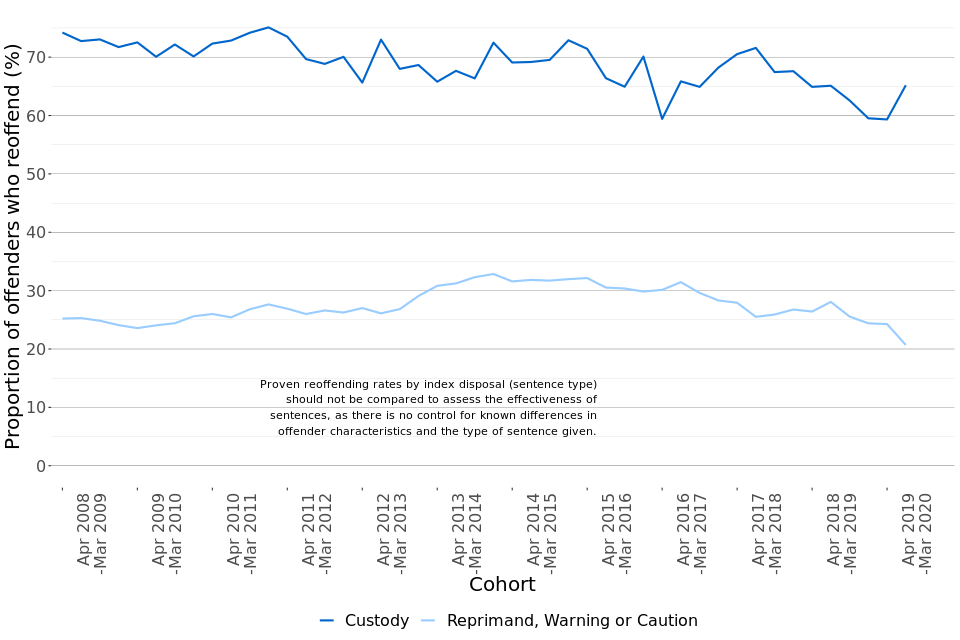
Between July to September 2019, 135 juvenile offenders were released from custody and 88 (65.two%) were proven to have committed a reoffence within a year (effigy 6). The charge per unit has increased by 0.1 pct points since the same quarter in 2018. There is, even so, likely to be more variation with the new reoffending mensurate, from i quarter to another due to the reduced size of the cohort.
8. Index offences[footnote 13]
As with previous cohorts, the index offence category associated with the highest reoffending rate for the July to Sptember 2022 developed cohort was theft at 48.8%.
The second highest reoffending rate of 34.seven% amongst developed offenders was those with an alphabetize offence of public lodge (figure vii).
Figure vii: Proportion of adult and juvenile offenders in England and Wales who commit a proven reoffence, by index offence (except the 'other' offence category), July to September 2022 (Source: Table A4a/b)
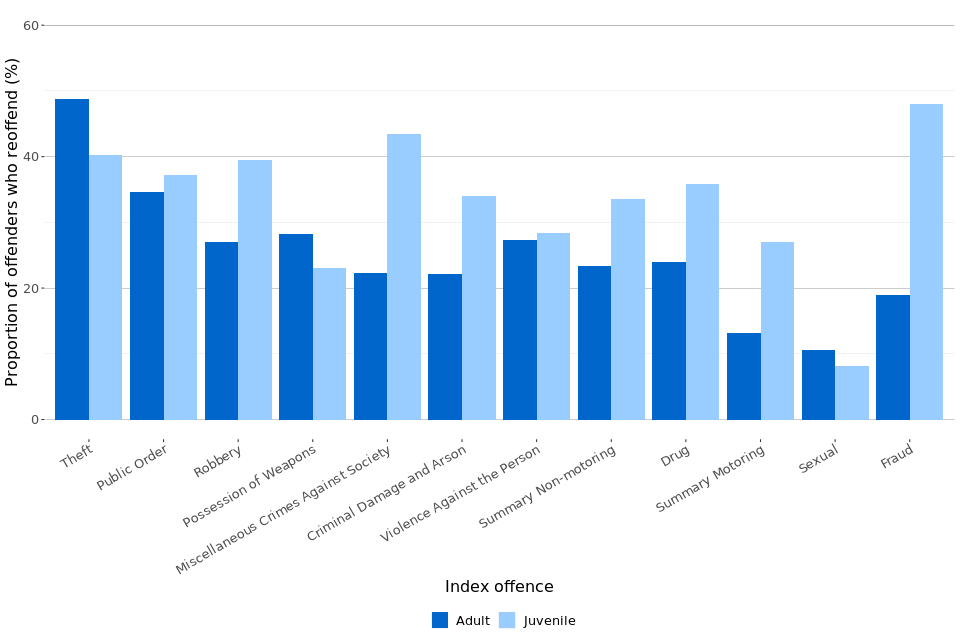
The proportion of reoffences committed depending on index offence has remained broadly stable over fourth dimension. The lowest rate of reoffending in the developed cohort was observed amongst those with a sexual offence as their index offence, with a charge per unit of 10.5%. Excluding the 'other' offence category, the miscellaneous crimes confronting society index offence category saw the largest percentage point decrease in reoffending rate since the same quarter in 2008, a 14.7 percentage point departure. Those with an index offence of violence confronting the person saw an increase over this menses, a v.4 percent point difference.
In the juvenile cohort, those with an alphabetize offence of fraud had the highest proven reoffending rate at 48.1%, followed by those with an alphabetize offence of miscellaneous crimes against society at 43.4%. Those with the lowest rate, excluding the 'other' offence category, were offenders who had committed a sexual index offence. Their reoffending rate was eight.2%. Those who committed possession of weapons index offences saw the largest percentage point decrease in reoffending charge per unit since the aforementioned quarter in 2008 (a 12.3 per centum betoken difference) whilst fraud index offences represented the biggest percentage point increase over the same menses (a 24.8 percentage point deviation).
nine. Farther information
Accompanying files
Equally well as this bulletin, the following products are published as part of this release:
- A ready of overview tables, covering each section of this bulletin.
- Two information tools providing proven reoffending data for England and Wales, by region, canton also every bit local authority (covering July 2008 - June 2022 and October 2008 - September 2019).
- A technical guide to proven reoffending statistics providing information on how proven reoffending is measured and the information sources used.
- A data quality statement which outlines our policies for producing quality statistical outputs and the information provided to maintain our users' understanding and trust.
9.one National Statistics status
National Statistics status means that official statistics meet the highest standards of trustworthiness, quality and public value. All official statistics should comply with all aspects of the Code of Exercise for Official Statistics. They are awarded National Statistics status post-obit an cess by the Authority's regulatory arm. The Authority considers whether the statistics run across the highest standards of Code compliance, including the value they add to public decisions and debate.
It is the Ministry of Justice'southward responsibility to maintain compliance with the standards expected for National Statistics. If we become concerned about whether these statistics are still meeting the appropriate standards, we will discuss any concerns with the Authorisation promptly. National Statistics status can be removed at any betoken when the highest standards are non maintained, and reinstated when standards are restored.
9.two Future publications
Our statisticians regularly review the content of publications. Evolution of new and improved statistical outputs is usually dependent on reallocating existing resources. Every bit part of our continual review and prioritisation, we welcome user feedback on existing outputs including content, breadth, frequency and methodology. Please transport any comments you take on this publication including suggestions for further developments or reductions in content.
nine.iii Contact
Printing enquiries should be directed to the Ministry building of Justice printing office:
Tel: 020 3334 3536
Email: newsdesk@justice.gsi.gov.uk
Other enquiries and feedback on these statistics should be directed to the Data and Belittling Services sectionalisation of the Ministry of Justice:
Liz Whiting, Head of Reducing Reoffending and Probation Statistics
Ministry of Justice, 7th Flooring, 102 Petty France, London, SW1H 9AJ
Email: ESD@justice.gov.uk
Next update: 28 October 2021
URL: world wide web.gov.britain/government/collections/proven-reoffending-statistics
© Crown copyright
Produced past the Ministry of Justice
Alternative formats are bachelor on request from ESD@justice.gov.uk
Source: https://www.gov.uk/government/statistics/proven-reoffending-statistics-july-to-september-2019/proven-reoffending-statistics-july-to-september-2019
Belum ada Komentar untuk "What Percent of Juvenile Offenders Reoffend Again"
Posting Komentar